Current fuel pricesEffective 15 July 2026
PetrolNLe33LitreNLe2
DieselNLe35LitreNLe5
KeroseneNLe37.25LitreNLe4.99
Fuel OilNLe30.22LitreNLe0.49
PetrolNLe33LitreNLe2
DieselNLe35LitreNLe5
KeroseneNLe37.25LitreNLe4.99
Fuel OilNLe30.22LitreNLe0.49
Fuel PricingNPRA Media & Public Relations Department

Government Subsidy Shields Consumers from Sharp Increase in Fuel Prices

The National Petroleum Regulatory Authority (NPRA) has announced that the Government of Sierra Leone's fuel subsidy programme has prevented a significant increase in pump prices despite continued upward pressure on international petroleum markets.

The National Petroleum Regulatory Authority (NPRA) has announced that the Government of Sierra Leone's decision to reintroduce fuel subsidies has prevented a substantial increase in domestic fuel prices, providing relief to consumers despite continued volatility in global petroleum markets.

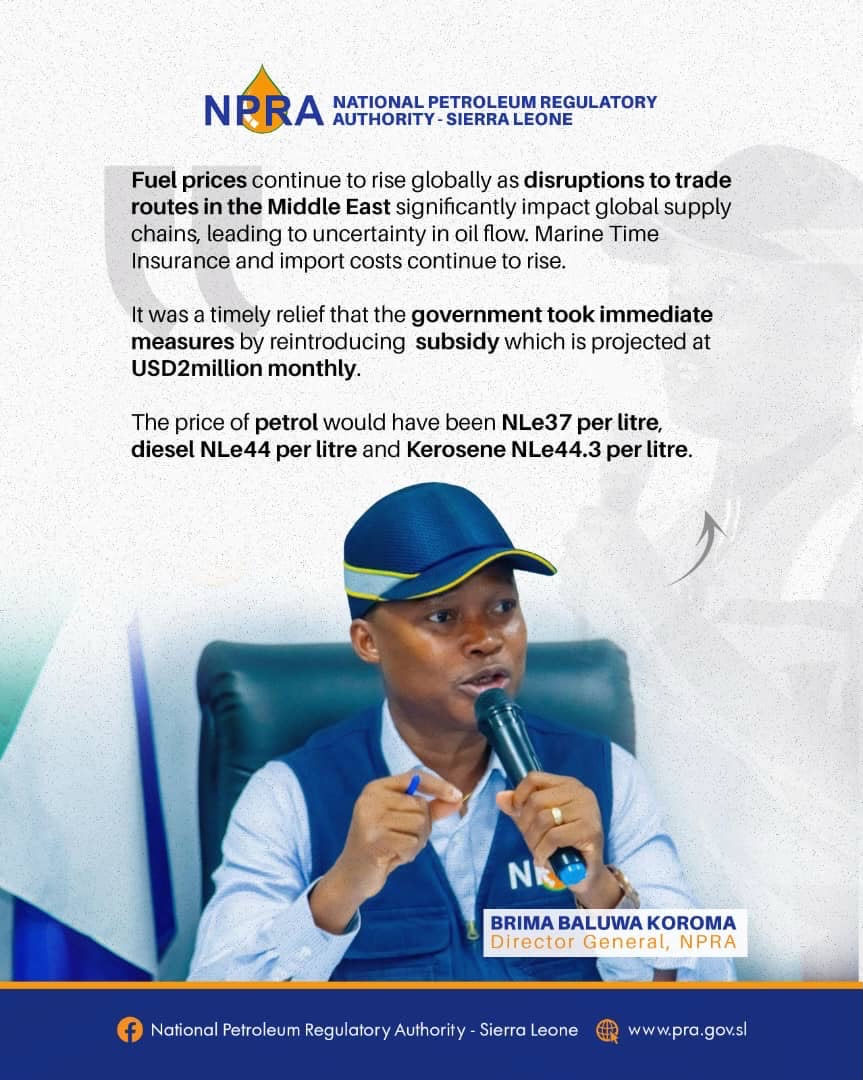
According to the Authority, international fuel prices continue to rise as a result of disruptions to major trade routes in the Middle East. These developments have affected global supply chains, increased uncertainty in oil transportation, and driven up marine insurance premiums and petroleum importation costs.

The NPRA explained that, without the Government's intervention through the subsidy programme, the retail pump price of petrol would have increased to NLe37.00 per litre, while diesel and kerosene would have reached NLe44.00 per litre and NLe44.30 per litre, respectively.

The Authority noted that the subsidy programme, which is projected to cost approximately US$2 million per month, has helped cushion consumers and businesses from the immediate impact of escalating international market prices while supporting price stability across the country.

The NPRA reaffirmed its commitment to continuously monitoring developments within the international petroleum market and implementing the petroleum pricing framework in a transparent and responsible manner. The Authority also reiterated its commitment to working closely with the Government and industry stakeholders to safeguard the security of fuel supply while protecting consumers from excessive market volatility.

As global energy markets remain uncertain, the NPRA will continue to provide timely information on pricing developments and measures being implemented to ensure the sustained availability of petroleum products throughout Sierra Leone.

Latest updates

Public updates

Official news, notices and media updates from NPRA.

All news ↗
Public guidance

Frequently asked questions

Quick answers to common public and operator questions about licensing, pricing and downstream petroleum regulation.

View all FAQs ↗
01How can I apply for a license with the NPRA?
  • Write a letter of intent addressed to the Director General, National Petroleum Regulatory Authority, A.J Momoh Street, British Council, Tower Hill, Freetown.
  • Depending on the business model, the Authority shall advise and give a time frame for licences to be granted.
Licensing
02What is a fuel subsidy?

A fuel subsidy is financial support provided by the Government to reduce the cost of petroleum products paid by consumers.

Fuel Pricing
03Does the Government set fuel prices?

Yes. Fuel prices are approved by the Government using the approved pricing formula to ensure fair, transparent and sustainable pricing.

Fuel Pricing
04How are fuel prices determined?

Fuel prices are determined using an approved pricing formula. The formula takes into account the international reference price for refined petroleum products (Platts), published by S&P Global, the exchange rate provided by the Bank of Sierra Leone, and other costs incurred throughout the petroleum supply chain.

Fuel Pricing
05Why don't fuel prices fall immediately when global prices decline?

Fuel prices are reviewed periodically to minimise the impact of short-term international market fluctuations and promote price stability.

Fuel Pricing