 9 July 2026
News
NPRA Director General Briefs Parliament on Petroleum Industry Developments
NPRA Director General Brima Baluwa Koroma briefed Parliament's Committee on Trade and Industry on developments in Sier…
Find answers to common questions on licensing, pricing, petroleum stock updates, documents, compliance and general enquiries.
Search by keyword or filter by category to locate relevant guidance quickly.
These responses are provided for general information. For formal licensing, compliance or regulatory decisions, contact NPRA through the official channels.
A fuel subsidy is financial support provided by the Government to reduce the cost of petroleum products paid by consumers.
We ensure fair market space by implementing regulations that foster competition, transparency, and equal opportunities for all industry participants.
Yes. Fuel prices are approved by the Government using the approved pricing formula to ensure fair, transparent and sustainable pricing.
Fuel prices are determined using an approved pricing formula. The formula takes into account the international reference price for refined petroleum products (Platts), published by S&P Global, the exchange rate provided by the Bank of Sierra Leone, and other costs incurred throughout the petroleum supply chain.
Fuel prices are reviewed periodically to minimise the impact of short-term international market fluctuations and promote price stability.
Crude oil is the raw petroleum extracted from the ground. Refined fuel is produced by processing crude oil and includes petrol, diesel and kerosene. Sierra Leone imports refined petroleum products.
The pump price includes the international cost of refined petroleum products, the prevailing exchange rate, taxes, levies, transportation, storage, distribution and other approved costs.
Yes, our team is available to assist with inquiries related to petroleum laws and regulations. Feel free to contact us for more information.
The National Petroleum Regulatory Authority regulates Sierra Leone's downstream petroleum industry by promoting safety, fair competition, consumer protection and compliance with applicable laws and regulations.
Periodic reviews help maintain market stability, reflect changes in international prices and ensure a sustainable supply of petroleum products.
Because petroleum products are imported in foreign currency, changes in the Leone–US Dollar exchange rate directly affect import costs and pump prices.
The pricing formula promotes fairness, transparency and accountability while balancing the interests of consumers, industry operators and the government.
The sector includes suppliers, importers, the government, Oil Marketing Companies, dealers, transporters and consumers, each playing a distinct role in the petroleum supply chain.
Petrol and diesel have different international reference prices, import costs and supply chain expenses, resulting in different pump prices.
No. Sierra Leone imports all refined petroleum products from international markets.
Yes. Refined petroleum product prices are influenced by refining costs, global demand, freight and supply chain conditions, not only crude oil prices.
Fuel prices change because international market prices, exchange rates and supply chain costs fluctuate over time.
International oil prices, shipping costs, exchange rates and global supply and demand all influence fuel prices in Sierra Leone.
Maintaining sufficient fuel stocks helps prevent shortages, supports market stability and ensures a reliable national fuel supply.
Selling petroleum products above the approved pump price is an offence and may result in regulatory enforcement by the NPRA.
Consumers can report overpricing or other violations through the NPRA's official telephone lines, WhatsApp channels or social media platforms.
Transparent pricing builds public confidence by ensuring fuel prices are determined using objective and verifiable criteria.
Processing times vary depending on the type of application and the completeness of the supporting documentation submitted.
Yes. Applications that fail to satisfy the Authority's technical, environmental or regulatory requirements may be refused.
Members of the public may contact the NPRA or consult official NPRA publications to verify the licensing status of a filling station.
Routine inspections ensure compliance with safety standards, operational requirements and environmental obligations.
Report the matter immediately to the NPRA with as much information as possible, including the location, date and any supporting evidence.
Yes. The NPRA regulates Liquefied Petroleum Gas (LPG) activities, including storage, transportation, distribution and retail operations.
Yes. The public is encouraged to report unsafe petroleum facilities or practices directly to the NPRA for investigation.
Quality testing ensures that petroleum products meet approved technical specifications before reaching consumers.
The Authority monitors compliance with approved prices, fuel quality standards and licensing conditions while investigating consumer complaints.
Any individual or organisation intending to undertake regulated downstream petroleum activities must obtain the appropriate licence or approval from the NPRA.
Safety distances reduce risks to nearby schools, hospitals, markets and residential communities and help protect lives and property.
Yes. The Authority may suspend or revoke licences where operators fail to comply with applicable legal or regulatory requirements.
Yes. Transportation of petroleum products is regulated to ensure safe handling, minimise environmental risks and protect the public.
Visit the NPRA's official website, follow its verified social media channels or contact the Authority directly for accurate and up-to-date information.
9 July 2026NPRA Director General Brima Baluwa Koroma briefed Parliament's Committee on Trade and Industry on developments in Sier…
 23 June 2026
NPRA Director General Baluwa Koroma engaged development partners and members of the Sierra Leonean diaspora at the ina…
 20 June 2026
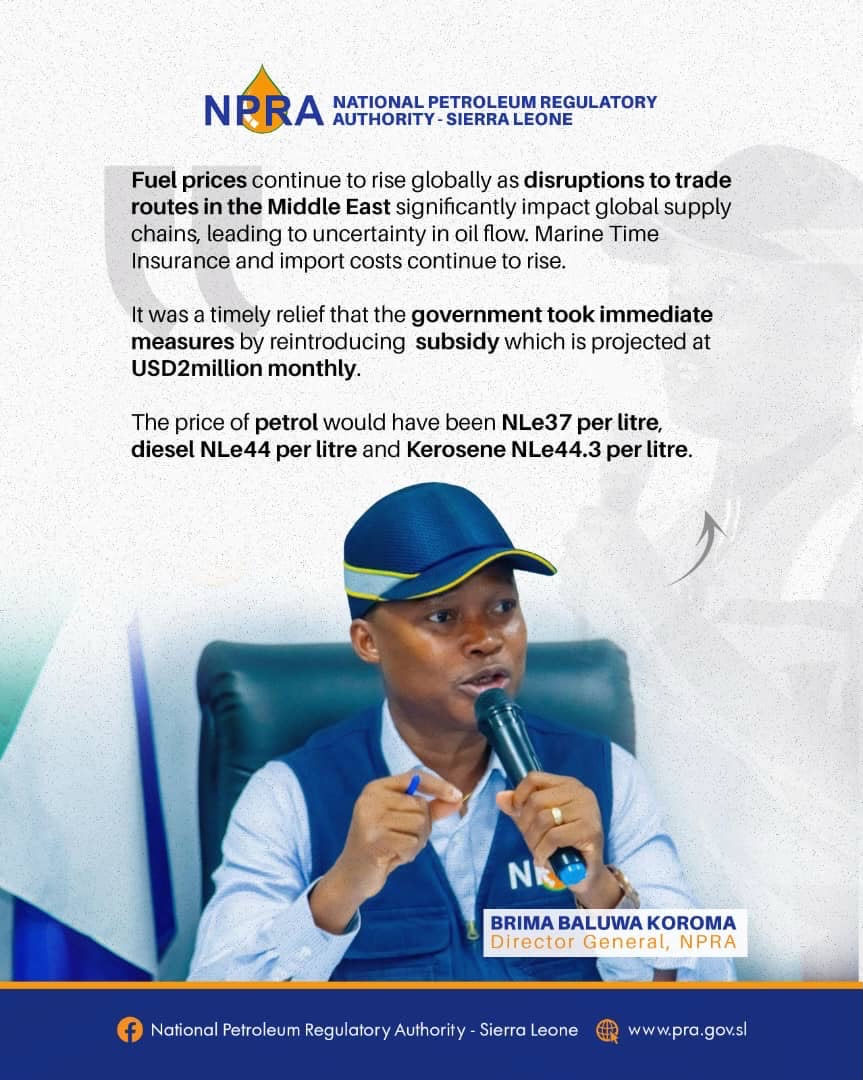
The National Petroleum Regulatory Authority (NPRA) has announced that the Government of Sierra Leone's fuel subsidy pr…
Quick answers to common public and operator questions about licensing, pricing and downstream petroleum regulation.
View all FAQs ↗A fuel subsidy is financial support provided by the Government to reduce the cost of petroleum products paid by consumers.
Yes. Fuel prices are approved by the Government using the approved pricing formula to ensure fair, transparent and sustainable pricing.
Fuel prices are determined using an approved pricing formula. The formula takes into account the international reference price for refined petroleum products (Platts), published by S&P Global, the exchange rate provided by the Bank of Sierra Leone, and other costs incurred throughout the petroleum supply chain.
Fuel prices are reviewed periodically to minimise the impact of short-term international market fluctuations and promote price stability.